See smoke pouring out of my eyes


smoke imageand other fascinating creations at the Digital Revolution show at the Barbican. Anyone in retail (or experiential marketing) will enjoy it. Why? With the growth of e-commerce the shop is changing-it has to evolve or die- and is becoming a form of entertainment in its own right

The digital instillations at the show are just the kind the thing that helps to reinvent the shop as a memorable experience.

The tech is expensive but as costs come down it goes mainstream – expect the likes of Nike,Apple and Burberry to pioneer it in their brand experience temples (which is what shops are becoming)

The early part of the show takes you through key stages in the history of gaming but it is the later parts that are worth dwelling on – fascinating cinematic quality animations,new ways of interacting with screens- and the story of how the film Gravity was made.

Behind this, I think,are two exciting trends

-gaming is very powerful,well funded and important in the UK and the inventiveness it has spawns flows out into all other kinds of creative work.

-Coders are now collaborating with artists and creators of all types-musicians, sculptors, painter, fashion designers. This cross fertilisation is making digital creativity somethings that appeals to all the senses.Physical,playful,fascinating.

Take the Nintendo Wii ( gaming again) and how it helped gaming open up to new audiences with its “gesture based wireless control interface” . Now that technology is being evolved in new and more creative ways. I for one could not resist seeing smoke pour out of my eyes.

Austerity Branding comes of age

For most of my career people have aspired to buy premium brands and just wanted an affordable way to buy into them – think of the Mercedes A class, Waitrose essentials or a tie from Armani. Premium brands used to “reach down”

But something has shifted in the culture – Value brands have captured the middle classes as extended recession has finally stripped away illusions.

Now to be cheap is chic and the next inevitable development in branding is for these cheap brands to smarten themselves up to reflect their new clientele. These images are from Chippenham High Street

Poundland now looks just fine to me and perhaps a coffee in the Greg’s cafe too ? Who wants to fork out £4-00 for a coffee in Starbucks ? Inside Gregs was just fine and dandy and you can get a sausage roll for 99 p.

IMG_2433IMG_2434

Justin King left Sainsbury at just the right time…Aldi and Lidl will be smartening up soon too no doubt to hang onto those newly converted members of the squeezed middle.

Since writing this post we have seen the first big beast to suffer the consequences – the CEO of Tesco-Philip Clarke– has stood down as his business has been battered by the discounters.

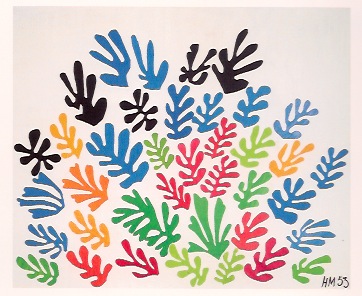
Matisse cut outs at Tate Modern

Matisse is the perfect artist for Tate modern. He already adorns a thousand pieces of merchandise from greetings cards to mugs so he is a good generator of  extra revenue through the well-positioned and well-stocked gift shop that (with Ikea like ruthlessness)you have to pass through as you exit the show.

He is joyfully easy to understand and has the mass appeal which exactly fits the Tate modern’s mission to convert modern art from being something for high minded elites into a mass cultural experience and driver of the tourism market.

He also has a great back story. These cut outs were created in the last 20 years of his life when he was increasingly sick and frail. They are a bright energetic and optimistic antidote to gloom, greyness and the dying of the light. A lesson for all those marketing to seniors and the grey market.

Like Elizabeth David and Sir Terence Conran he seems to me to have captured the zeitgeist atScan 2Scan 3 the right time – bringing a blast of bright mediterranean light, design and freshness to gloomy 50s’ Britain.

What does the internet of things mean for you ?

Much hype in the media about how the things we own (cars,beds,fridges,boilers,mobiles,wearable devices yet too be invented) are going to make our lives better. The revolutionary nature of the change becomes apparent when you examine what the benefits to people might be at market by market level.

Easier – because things automatically happen -such as your car booking its own service.

Safer-because devices – think of a home water detection device- can automatically report a problem. Or a car that spots that the car two in front has suddenly braked

Cheaper – because devices may identify waste or overuse and help you make economies or even reward good behaviour with cheaper prices. Think of a device in your car that monitors your driving speeds and the amount of driving you do and gives you a personal insurance price.

Healthier -devices on our bodies or in our beds can monitor your training regime or spot an remerging problem such as elevated heart beat or blood pressure

Sounds good – the fact that a) You can identify big easy to understand benefits and b) the technology is cheap and getting cheaper suggest this is a revolution. Like most revolutions it will happen slower than you think. The mobile revolution – much trailed over the last decade- is only just upon us. As Niel Amstrong once said ” We expect too much change in a year and too little change in a decade”.

We are getting used to the idea of devices automatically responding to our behaviour from using apps and the Internet more generally. We know that google serves up ads that reflect what we are searching for.Sites use cookies and mostly we don’t disable them  Our behaviour is being monitored we know that. Internet use and app use soften’s us up for “the internet of things”

So what can go wrong? Plenty 

Strip away the devices and ask what does this really mean?  – it means

lots of devices reporting on your behaviour. Are you happy with that ? well yes if it prevents a flood in my home or prevents a heart attack, but no if some big brother insurance company penalises me  for driving at 80 in 70 mile a hour road – many of use do that on a motorway.

lots of data on your behaviour being delivered to organisations that you hope will use it in a way that is in your interests rather than theirs. The benefits above are appealing but not if what you end up believing is that the data is mainly being used to sell you things you don really need.

Then there is infrastructure and technology. The much promised electric car revolution is stalled/ very slow because of a lack of recharging points and batteries that won’t take you long distance.

The internet of things will be plagued with this – software that does not talk to other software for example.

Expect many conferences on the internet of things over the coming decade. Expect the hype to run ahead of the reality. But in a decade expect industrial design to be very different. Chips with everything- and i don’t mean the fried sort.

Bad language

I have just had an out burst in this quarter’s Market Leader (quarterly journal of the Marketing Society-subscribe here) about the use of jargon in marketing – which my daughter read and described as pompous.

Perhaps I have reached a pompous age – must do something as an antidote

See Cword

It was inspired by Orwell’s essay Politics and the English Language – in which he wrote

“the slovenliness of our language makes it easier to have foolish thoughts”

and

“If thought corrupts language ( think of the dead language of the communists) language can also corrupt thought”

My brain food plan for 2014

There is a direct correlation between the quality and range of stimulus you take in and the freshness the ideas you put out- lots of books about creativity and many creative types in agencies attest to this.

In fact if your read  Daniel Kahnemann this kind of mental priming can almost determine what kind of idea you have. If I show you lots of pictures of cute fluffy cats and doe-eyed dogs there is a high probability you will end up featuring them in your next piece of creative work.

A diverse diet of brain food is obviously what’s needed. This is what Edward de Bono advocated. He thought fresh ideas came from deliberately seeking  random stimulus and used dice throwing to alight on unexpected words.

So it is not going to be enough to subscribe to feeds from the likes of springwise or contagious ( good though those services are) because frankly every other creative or strategy type in communications is doing it too. TED talk provide useful distractions but are a kind of  idea porn-you look at it for 20 minutes and get excited but you don’t really get involved. It may be enough for some but is it really satisfying?  Videos on the RSA website are deeper and more thought provoking anyway

Which brings me to my brain food plan for 2014. which is to take at least  half day a month and visit one of the many exhibitions in available in London and report back.

First up Hannak Hoch at the Whitechapel (one of those wonderful London institutions which is at the heart of the artistic community in East London)

As one of the originators of Collage Hoch fed off popular culture and created witty and subversive artworks through  juxtapositions of found images.

One of the best bits of this show is that you see her creative process laid bare in her scrap books- she was constant collector of images that she found powerful. She had obsessions- cute cats and naked native women for example- and used this as starting points for her works. Then she went in search of images that seemed to fit – a serendipidous and random process that produced fresh and surprising work. It is lesson in the importance of fresh stimulus, collecting stuff and playfulness. All things that people thing they don’t have time  for

My Score 8 out of 10.

And hurry because the show finishes on 23/03

Here are three of my favourite images from the show

Scan 1

Scan 2Scan 3

News from China

I went to the 6th annual LSE SU China Development forum yesterday – this is my third visit to the forum with my son Oliver – who is fascinated by all things Chinese. What stood out this time ?

Liberalisation and opening up ? 

last year there was much excited anticipation about the upcoming third plenum when new premier Xi would lay out his reform agenda. These may be ambitious but do not appear to include a freer media:-

-250,000 journalists have to sit an exam in “Marxism news value”is they are to get accreditation- in other words they will find it difficult to work without having studied the 700 page manual that goes with the course.

-New deans of the top journalism schools are mainly party officials

-Those investigative journalists-who expose malpractice, corruption and incompetence-have to be very brave souls and face harassment or worse :which necessarily reduces the numbers who will do this kind of work.

Certainly there has been a technological revolution with mass penetration of internet access and use of blogs and microblogs. But these are still monitored closely. It is an ambiguous world in which truth tellers have to intuit how close they can sale to the wind and read the shifting sands of official sanction.

Chinese Soft Power- perceptions of China abroad

Sir Christopher Hum, former ambassador to PRC, gave his scorecard on how China was doing on soft power.

He noted that much soft power in China is government sponsored – which may not be a recipe for success.

Good things he noted were

-Chinese art market – booming exciting and creative and thoroughly free of the state

-Confucian institutes to promote language and culture – they do just that and are not used as mouthpieces of government

-Chinese diplomats have got much better at dealing with the media

Not so good

-Chinese films- after a flurry of excitement over a decade ago with the likes of Crouching Tiger Hidden Dragon  Chinese film has stalled because the good recent films by the likes of Jia Jhang-ke ( see The World which is very good in a bleak way and Platform) tend to present a “realistic” view of Chinese society and so incur official displeasure. A recent Chinese film festival in london exited very little interests as it did not showcase this more challenging work.

-Official media abroad :CCTV and Xinhua have expanded their operations but are too “stiff” and to self evidently government mouthpieces to win big audiences. They need more independence and better journalism – take a leaf out of Al-Jezeera’s book

-Leadership’s new big idea- The China Dream is big in China but has little traction abroad. China politically abroad reflects two ideas of “guided capitalism” and “a one party state”. This has not exported well. The American Dream of a land of freedom and opportunity is still much more appealing to populations around the world ( if not their politicians).

-Foriegn relations and domestic security: China’s approach in its own back yard and regionally excites apprehension and anxiety.

Treatment of Tibet, Falun Gong and Liu Xiaobo reflect the insecurities of a security driven state.

This of course is partly real – China is still encircled by alliances made by USA with Japan and Taiwan after WW2. Just because you are paranoid it does not mean that people are not out to get you. The USA is widely thought to have planted malware in Chinese computer systems to be activated in the event of conflict.

– Chinese (and Japanese leaders) have failed to move on from the “mutual hatred” – the phrase was used by a former US diplomat- created by WW2 atrocities. Chinese  leaders are all to ready to use nationalist sentiments as a way of shoring up their position. This looks like weakness not strength and people see it for what it is.

Chinese Business goes abroad in order to come back home stronger

M&A is booming- up from $1bn in transactions a decade ago to $50bn last year- 10 years ago it was all about securing energy and now it is across the board-consumer, industrial etc

One of the big motivations for Chinese companies is not so much to penetrate foreign markets as to buy the expertise and brand reputations too help them gain an edge in the (potentially huge) home market- they “go out in order to come back”

Good examples are Geely buying Volvo , Lenovo buying IBM’s PC and now Motorola’s mobile division (from Google) and Bright Food’s purchase of Weetabix. Example financial services M&A to follow as Chinese banks follow Chinese business investment around the world.

What I have learnt from 10 years of running training courses.

It is 10 years since I published The Communications Challenge (APG 2004), which opened the door for me to many opportunities to run training courses – on all continents (except Antarctica) for both agencies and clients.

10 years on – what have I learnt?

I hope these notes are useful to anyone commissioning research or those looking for a satisfying new career in business education or as a trainer.

Most useful preparation for being a good trainer

For me it was learning to design and moderate groups discussions (whilst a planner at Ogilvy). In fact writing a book only gets you business it does not make you a good trainer. Nor does being a great presenter. In fact I fancy myself quite a bit as a presenter- but this can lead you to think it’s all about giving a great performance. It’s not. People learn very little from a power point and get bored after 45 mins with an egotistical presenter.

Remember you are designing an interaction

People learn from the holy trinity of interaction, stories and examples. And of these three the most important is interaction – with the trainer and each other. Quite a lot of the value that people get from training comes not from listening to the trainer but getting to know each other and how to work with each other. In a lot of client organisations people work in silos and the culture is not conducive to team working. As the trainer your are enabling this to happen. People enjoy this and it is a blessed release from the daily grind.

Think of presentation as the introduction of stimulus for the next interaction

As a general rule you should have only about 10 slides before having a break out or discussion – if people are particularly responsive presentation can be done as a form of live interaction rather than “sit and listen”. Introduce only one idea and illustrate it with examples during your 10 slides – which should be mainly pictures and carry as little text as possible.

Make sure your delegates want to be in the room.

The trainer needs to bring a lot of energy into the room – but you will only have a great session if it is reciprocated and your delegates want to be there.  Their bosses need to position training a benefit to delegates and you should avoid situations if possible where people have been “told to go to the training”. It will not go well. Similarly if the organization you are training is about to be “restructured” or “downsized” delegates will not be in the mood for -as they will be distracted at best and pissed off at worst.

Find out about your delegates

It is a good idea to ask delegates to fill in a pre-course questionnaire to find out about their hopes and expectations and use what you have found out in the workshop – be flexible.

Delegates want the trainer to be “on receive” and not just “transmit”

Leadership from your client is vital.

Your delegates need to know that the training is important to the organization so you need endorsement from the leader- preferably in person at the start of the session.

You need to lay down the rules

The bane of your life as a trainer is the mobile phone – it used not to be 10 years ago and now it is very difficult to stop those itchy thumbs – especially if your delegates work for an organization where the culture is to respond to emails very rapidly. You can try taking mobiles away provided you understand that your delegates may see this as an assault on their human rights.

Evaluate at the end

Ask delegates to fill in a short evaluation questionnaire at the end. Over 10 years I have learnt a lot from these- especially the point about interaction above

People almost never reference the quality of presentation – they do appreciate a trainer who listens and interacts. They do also recognize when you “know your stuff” and have asked questions and received a thoughtful replies.

Never get stale

I rarely run exactly the same course twice – I normally learn something from running a session and want to make improvements and/or refresh and update the examples I use. For the topics I cover this is essential and there is always new creative work and, embedded in this work, are new ideas about what will be effective. Especially now.

Best countries to run training

Sadly not my own. Brits can be very complacent. In countries like Pakistan, Brazil, China and Nigeria there is a visceral hunger for knowledge and people bring energy and enthusiasm to the workshops. Training in the USA represents some challenges as Americans think of themselves as top dogs and they see themselves as dishing out the advice and not receiving it. (Brits are guilty of this too). So if you are a Brit training in the USA you need to partner with an American.

 What have been my favorite training courses?

Logic and leap – with Patrick Collister A planner (me) and a creative director (Patrick) take you from brief to creative idea in one day – we ran this with independent creative agencies in various parts of the world including RSA (Jupiter Drawing Room), Ireland and Finland. A privilege and a pleasure

Media Creativity Workshop for Unilever- from new product idea to innovative use of media in one day. Agency people and Unilever folk all in one room. A very good mix people learnt a lot from each other. This ran internationally.

Account Planning for Account Directors – bright and ambitious agency folk are always a joy. This also meets a big need- all those agencies out there that what to be better at the strategy bit yet cannot afford to hire a lot of planners.

Any disappointments?

These days I normally work alone – and the reason is budgets. This is a pity.

In the early part of the last decade I was often partnered up. And this made it a lot more enjoyable and less knackering.  So if there are any trainers out there looking for a partner please do get in touch

Please, please, please can we ban the C word?

Words get stripped of their meaning if used too often.

There is a phrase for this- semantic satiation: a word progressively loses its potency through over repetition. The marketing business positively over flows with such words and phases as Brand, Engagement, Target Audience, Core Values and, my particular bug bear, Content.

The C word is very hot now and turbo charged by all manner digital marketing.

Does this overuse of certain words matter?

I think it does – because we stop thinking about what words mean. They cease to have a personal impact and pass into the territory of important sounding positive buzz words that we can intone in the sure knowledge that we will not be challenged to say exactly what we mean.

Words become something we can hide behind or just a way of a particular group of people signaling that they belong the same professional tribe.

Flatulent language leads to sloppy thinking. So at the risk of farting in church ( as  one Australian Creative Director  put it to me ) I am going to suggest some  alternatives to our most overused words.

Can we ban the Brand word?

Probably not- Brand is written into the valuation of too many companies. Yet Brands are things companies own with famous logos that people can hide behind.

What if we used the word Reputation more often?  Reputation is personal – it is precious thing and can be won or lost depending on how you behave. “Your reputation is at stake” sounds like something I should worry about. “The brand is at stake” sounds like something that other people might worry about.

 Can we ban the Values word?

It is a very high-flown word for an activity, which should be daily and down to earth. Going on about Brand Values is all very well if you are John Lewis or Apple but most companies do not have clear brand values that staff can understand and live up to. What if we used two old fashioned words like civility and decency.  Decency as Orwell said is that “intuitive sense of morality that exists among common people.” It was what we expect and hope for from each other – it’s therefore a guide to behavior that anyone can understand.

Engagement used to be lovely word (as in “engaged to be married”) but now it has been taken over by agencies who are using it a version of “soft selling.” Most people can spot the difference between pretend engagement to make a sale or the real thing.

Real engagement normally starts with listening or empathy because you cannot engage without understanding.  This may lead you to offer advice that is objective, timely and helpful. Or it may lead you to give pleasure and entertainment as a release from the grind of daily life. It may be a genuine act of generosity with no immediate expectation of a return. Most people can spot a bribe -it is a transaction not an engagement.

Which brings me to my pet hate- the C word- Content.

It has never been a good word. It suggests yet more digital detritus being pumped out to an indifferent world.

Would you like more branded content, madam?

No thanks.

What I really want is something that interests me or is relevant to me – like entertainment, rewards, advice, ideas, pleasure, excitement, things worth sharing, the inside track.

But please not more Branded Content.

Now ,It is not easy to replace the C word as it is a portmanteau term without a ready synonym. But it manages to be both bland and flatulent. My modest proposal is that we ban it.

There is a free lunch on offer to anyone who can come up with a better word.